ISLAMIC PRINCIPLES ON SUSTAINABLE DEVELOPMENT
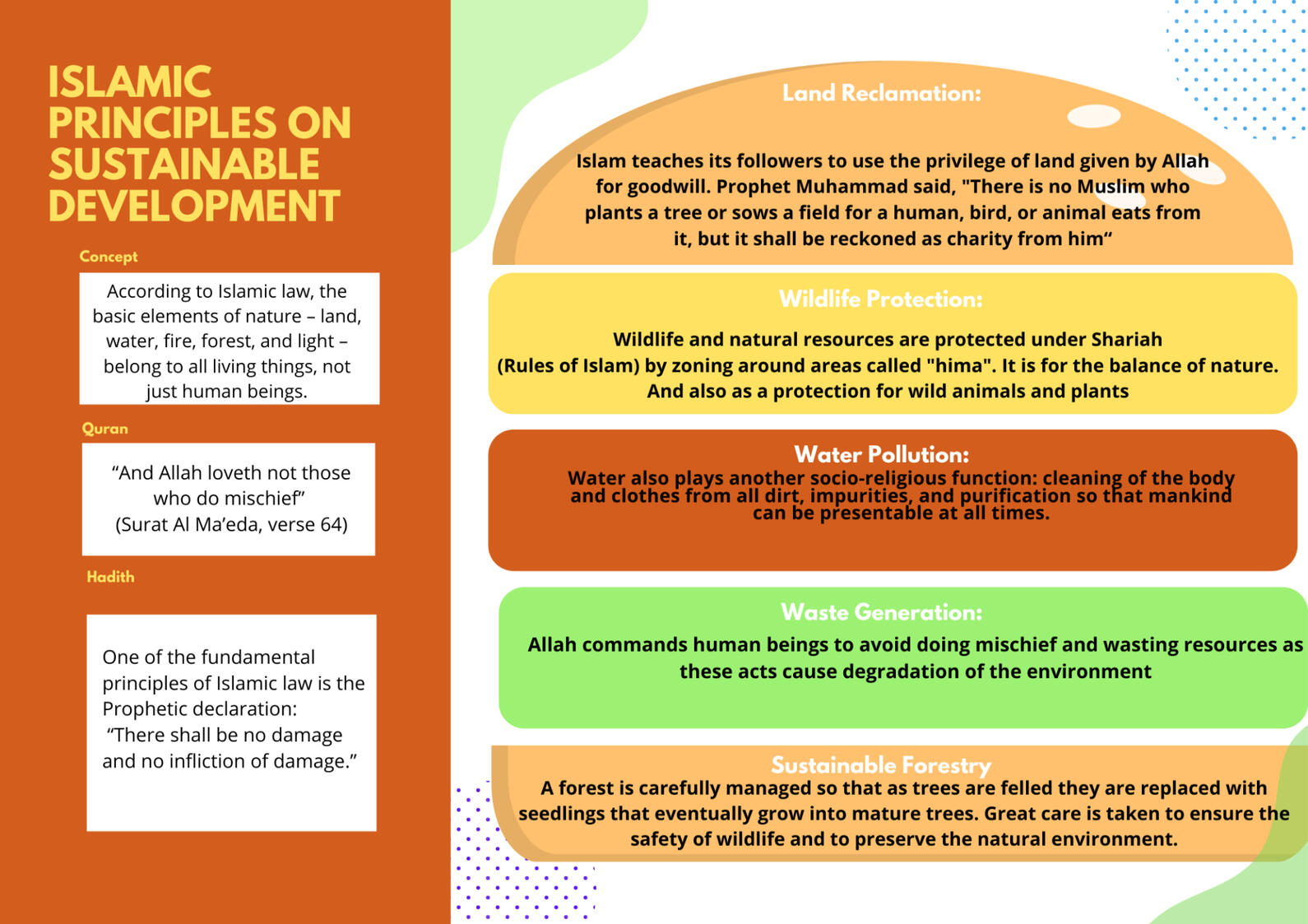
A large number of verses in Qura’n and other sayings of the Prophet Muhammad show the great significance that has been given to environmental issues and the duty of man to the world. The idea of sustainable development in Islam can be defined as “The balanced and simultaneous realization of consumer welfare, economic efficiency, attainment of social justice, and ecological balance in the framework of an evolutionary knowledge-based, socially interactive model defining the Shuratic process”. The Shuratic method is Islam's theory of consultation or engagement.
In Qura'n, the Earth is listed 61 times. The world has been formed by Allah (God) for a particular intent only for a limited time, according to Islam. The use of natural resources is a precious trust placed in the human race, a simple management, and not an owner, a recipient, not a disposer. The use of the gifts of Allah. The use of natural resources. The Islamic nation has been named side by side (ummatan) wasatan) the moderate nation of the Qur'an, a country which in every way avoids excess. Thus, Muslims, in particular, must make responsible use of the earth, keep it honestly and conserve it, make use of the earth and transmit it in excellent condition to future generations. This involves appreciating its uniqueness and bringing it back to the worship of Allah in a manner that realizes it.
LAND RECLAMATION
"Prophet Muhammad said, "Anyone who brings dead land to life is a reward in it for him, and whatever creature finds food from it is counted as charity from him. "On another occasion, the Prophet said, "There is no Muslim who plants a tree or sows a field for a person, insect, or animal to eat from it, but it is counted as charity from him"; and, "If someone plants a tree, without it being counted as charity from him, no human or any of the creatures of Allah can eat from it. This attests to the value given by the Prophet in the early days of Islam to the reclamation of land and the fair rights of all creations of God to benefit from the earth's riches.
WILDLIFE PROTECTION
"Under Shariah (Rules of Islam), habitats and natural resources are protected by zoning around areas called "hima". In such areas, industrial production, habitation, intensive grazing, are not permitted. Such 'hima' zones were created by the Prophet himself, followed by the Caliphs of Islam, as public property or common lands administered and maintained by public authorities for the protection of natural resources.
WATER POLLUTION
Water also serves another socio-religious function: the washing of all dirt, impurities, and purification of the body and clothes so that humanity can be viewed at all times. Muslims are only approved to pray after washing with pure (colorless, odorless and tasteless) water. In a place that has been washed, one can just pray. Islam emphasizes the avoidance of water quality contamination in light of these facts. In Islam, urinating in water (discharging excess water into water streams) and washing or bathing in stagnant water are illegal activities. "No one should bathe in still water when he is unclean," the Prophet said.
WASTE GENERATION
Islam advocates for the use of natural resources efficiently and the minimization of pollution. God says in Qura’n: “Eat and drink, but waste not by excess; “He” loves not the excessive”, (Al-A’raf 7:31). “And do not follow the bidding of the excessive, who cause corruption in the earth and do not work good”, (Ash-Shu’ara 26: 151-152). “And do not cause corruption in the earth, when it has been set in order”, (Al-A’râf 7:56).
SUSTAINABLE FORESTRY
Islamic law on the protection of trees and plants is embedded in the Prophet's Qura'nic teachings. "They include the following: "In the Afterlife, whoever plants a tree and diligently looks after it until it matures and becomes fruitful will be awarded" and "If someone plants a tree or sows a field and men, beasts or birds eat from it, he should accept it on his part as a charity. As a positive activity, he is also stated to have advocated tree planting, saying that even though one hour remains until the final hour and one has a palm-shoot in his hand, he can plant it. Muslim elders, such as Abu Baker, urged their troops not to cut down trees and damage agriculture or slaughter livestock except in times of battle.